
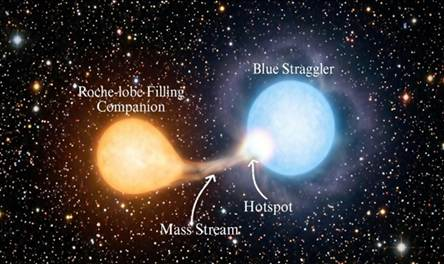
Blue straggler stars are hotter, brighter and more massive than other stars of similar age in the same stellar cluster. Their youthful appearance has puzzled astronomers for decades because they appear to have avoided the normal ageing process of surrounding stars.
The newly identified object is believed to be in the process of gaining mass through interactions with a companion star. This ongoing mass transfer rejuvenates the star, making it appear younger and more luminous than expected. Observing such an active formation stage is exceptionally rare and provides valuable insights into the mechanisms responsible for creating blue stragglers.
The discovery also supports the theory that many blue straggler stars are formed through mass exchange in binary star systems rather than through direct stellar collisions. Researchers say the observation will help refine models of stellar evolution and improve understanding of how stars interact over billions of years.
The findings are expected to advance knowledge of the life cycles of stars and the evolution of star clusters, offering fresh clues about the complex processes that shape the universe.