
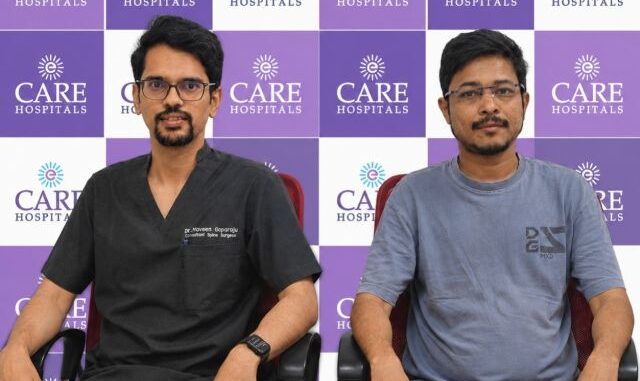
34-Year-Old Man Regains Ability to Walk Comfortably After Timely Treatment
• Patient was gradually losing his ability to walk due to a rare complication of Beta Thalassemia
• Doctors performed a complex spine surgery to remove pressure on the spinal cord and prevent possible paralysis
• Early diagnosis and timely treatment helped restore mobility and prevent permanent disability
A 34-year-old resident of Manikonda, Hyderabad, who was gradually losing his ability to walk due to a rare complication of thalassemia, has regained mobility after doctors at *CARE Hospitals, Hitech City* , performed a complex spine surgery that prevented possible paralysis.
The patient, Surfaraz Takkalapalli, a known case of Beta Thalassemia, had been struggling with worsening balance and walking difficulties for the past several weeks, there has been a recent onset of loss of urinary control Concerned about his deteriorating condition, he sought specialised care at CARE Hospitals.
After detailed investigations, doctors found that abnormal blood-forming tissue had developed around his spine and was pressing on the spinal cord, the structure that carries signals between the brain and the rest of the body. Doctors explained that while thalassemia primarily affects the blood, in rare cases the body may produce blood-forming tissue outside the bone marrow. When this tissue develops around the spine, it can put pressure on the spinal cord and affect movement and balance.
Doctors said such complications are uncommon in patients with thalassemia and can often be missed in the early stages, as symptoms may begin with mild imbalance, weakness, or difficulty walking.
The condition was affecting the spinal cord across a large portion of the upper and middle back. If left untreated, the pressure on the spinal cord could have caused permanent nerve damage, loss of mobility, and paralysis.
Recognising the seriousness of the condition, a multidisciplinary team at CARE Hospitals planned immediate surgical intervention. The patient underwent a complex spine surgery to remove the abnormal tissue and relieve pressure on the spinal cord. The surgery involved relieving pressure along a large portion of the patient's upper and middle spine(Thoracic), making it a particularly challenging procedure.
The procedure was performed by *Dr. Goparaju Praveen, Consultant Orthopaedic Spine Surgeon* , with support from Anesthesia Team.
Speaking about the case, Dr. Goparaju Praveen said, “This is a rare but serious complication seen in some patients with thalassemia. The pressure on the spinal cord was affecting the patient's balance and ability to walk. If treatment had been delayed, his condition could have worsened significantly and affected his ability to walk independently. Timely surgery helped prevent permanent damage and improve his mobility.”
“Many people ignore symptoms such as difficulty walking, imbalance, leg weakness, numbness, or persistent back pain. In patients with underlying blood disorders, these warning signs should not be overlooked, as early diagnosis and treatment can prevent permanent disability,” Dr. Goparaju added.
Following the surgery, the patient recovered well and was closely monitored before being shifted to the ward. With appropriate treatment and rehabilitation, his balance improved significantly, and he was able to walk more comfortably and independently. Today, he has regained his mobility and is gradually returning to his normal daily activities. He was discharged in a stable condition.
Doctors advised that people living with thalassemia and other long-term blood disorders should seek medical attention if they experience symptoms such as persistent back pain, weakness in the legs, numbness, loss of balance, or difficulty walking, as these may indicate pressure on the spinal cord requiring urgent treatment.
The successful outcome highlights CARE Hospitals' expertise in managing rare and complex spine conditions through advanced surgical care, multidisciplinary expertise, and timely intervention, helping patients regain mobility and return to their normal lives.